

+918048031859

Currently it only shows your basic business info. Start adding relevant business details such as description, images and products or services to gain your customers attention by using Boost 360 android app / iOS App / web portal.

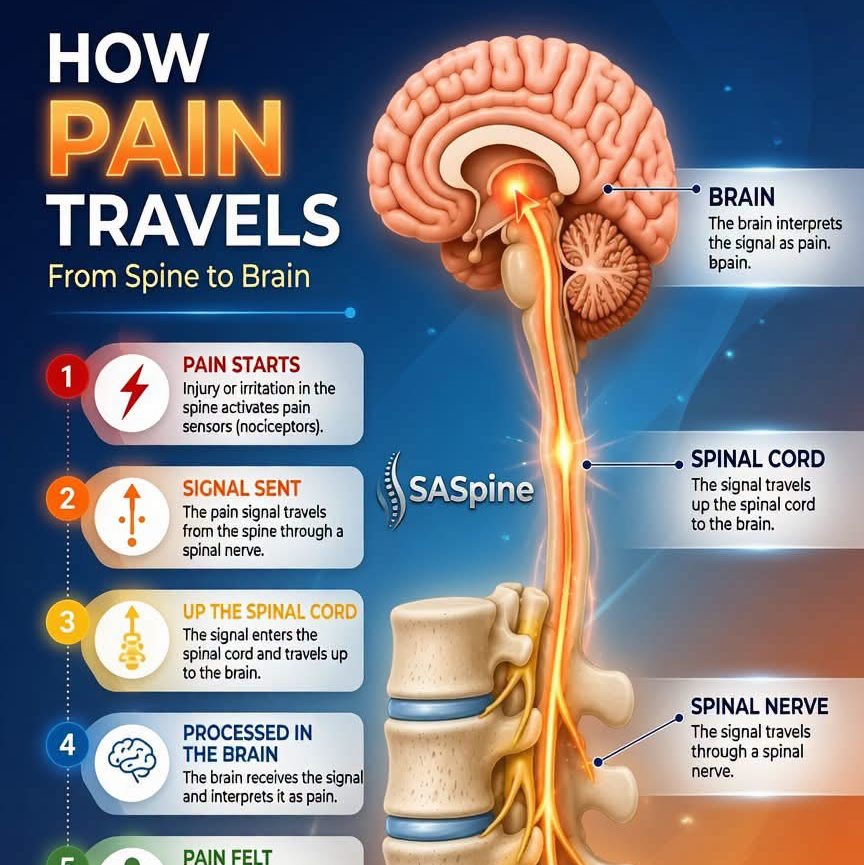
How does pain travel from your body to your brain? It’s a lightning-fast journey along the Spinothalamic Tract your main pain pathway. Here’s the 3-step process: STEP 1 – THE ALARM Nociceptors in your skin, muscles, joints, and the outer layers of your spinal discs detect damage or irritation. Fast A-delta fibers send sharp, immediate pain while slower C fibers carry burning or aching sensations. The signal enters the spinal cord at the dorsal horn. STEP 2 – THE RELAY The signal synapses in the dorsal horn, crosses to the opposite side of the spinal cord, and races up the spinothalamic tract toward the brain. This ascending pathway is where many advanced treatments work to interrupt chronic pain signals before they reach higher centers. STEP 3 – THE PERCEPTION The thalamus routes the signal to the somatosensory cortex — and you consciously feel the pain. Other brain regions (including those involved in emotion and memory) add the “suffering” component that makes pain feel overwhelming. This is why treatments work at different points along the pathway Epidurals calm inflammation and quiet the initial alarm at the irritated nerve or disc Spinal cord stimulators modulate signals in the spinal cord to reduce what reaches the brain Certain medications help change how the brain interprets and amplifies the signal As a spine surgeon, I find that when patients understand this pathway, they feel more in control — and we can choose more precise, targeted interventions instead of just masking symptoms. Pain isn’t just a signal it’s a full conversation between your body and brain. The better we understand it, the better we can treat it. Drop a like if you learned something new, and comment “PAIN” if you want me to break down how specific conditions like disc herniation or stenosis affect this pathway.


